WCRS Podcast - Civically Engaged

Sherrod Brown, John Boehner and Keystone XL plus food sovereignty activist and author Eric Holt-Gimenez

On February 14 a group of concerned citizens opposing the Keystone XL pipeline visited the Columbus office of Democratic senator Sherrod Brown.

Andrew Sidesinger works with 350.org here in Columbus Ohio.
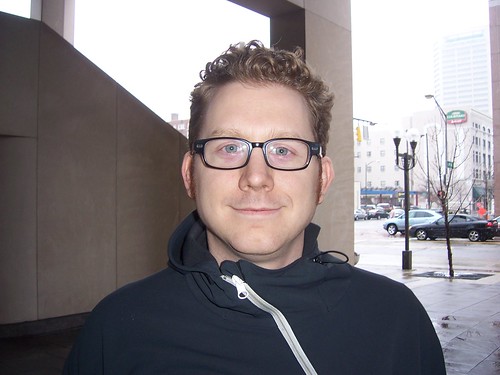
Andrew Sidesinger

“ We delivered 1,800 350.org petitions against Keystone XL. We have more than 20,000 in general from all the partner organizations in Ohio and we just gave him (Sherrod Brown) the message that if we want good, clean energy jobs we have to stop being behind fossil fuels and start being behind clean energy.”

Joining Sidesinger for the visit to Sherrod Brown’s office was Jason Box, a climatologist at the Ohio State University.
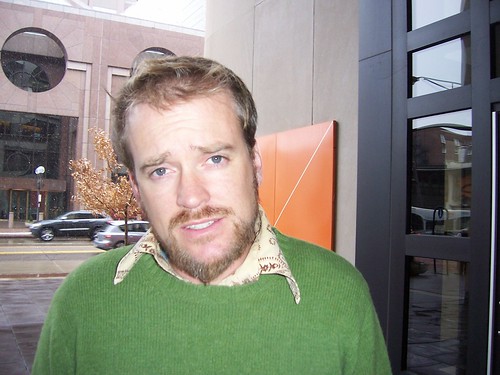
Jason Box, Ohio State University climatologist

Box said the tar sands are a pool of carbon as large as that of Saudi Arabia.

“We cannot release this carbon to the atmosphere without locking in additional, dangerous amounts of warming in our climate system.”

Box said now’s the time to have policy that will build a clean energy infrastructure.

“The renewal energy infrastructure that we need can employ millions of Americans in long-term jobs.”

Box said this view is supported by the facts. He said he visited Sherrod Brown’s office to send a clear message against Keystone XL, as a scientist and as a concerned citizen.

Alec Johnson said it would be a smart move for Sherrod Brown to take a stand against Keystone XL.


17:52 minutes (16.36 MB)

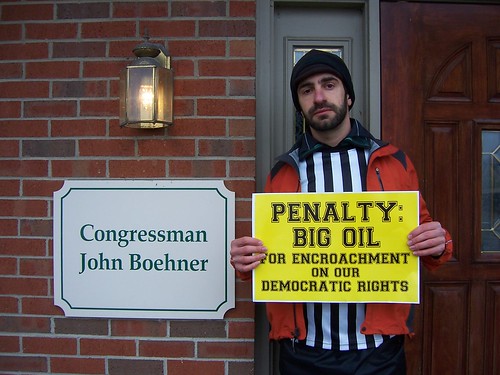
Congressman John Boehner using false numbers to push for Keystone XL, says activist

John Boehner using false jobs numbers to push for Keystone XL, says activist (See also EcoWatch

Danny Berchenko of 350.org Ohio said Speaker of the House, John Boehner is touting false numbers as part of his conflict-of-interest, due to his investments in big oil companies, and due to the $1 million the Republican Congressman has taken from the fossil fuel industry during his time in office.

“He’s claiming 20,000 jobs will be created. Those numbers are from a biased study by the company that will build the pipeline if the permit is approved.”

Berchenko said independent analyses show that building Keystone XL would create, at most, 5,000 temporary jobs and only 50 permanent jobs.

“It very well could kill more jobs than it creates, because the pipeline would run over sensitive farmland in the nation’s heartland and a key aquifer that feeds farms irrigation water.”

Berchenko said the Keystone Pipeline (not to be confused with its proposed extension, Keystone XL ) has leaked 12 times in as many months.

“Rather than if, it’s when the pipeline leaks, that will affect farmers and farmers will see their livelihoods lost and we’ll see other jobs lost from this as well.”

Berchenko said clean energy legislation would lead to incentives for the creation of millions of renewable energy jobs.

“We have so much more potential…thru building solar panels and windmills right here in America and thru retrofitting our buildings. Those are jobs that can’t be shipped overseas. We can’t uproot a building and send it to China to be retrofitted.”


3:44 minutes (3.42 MB)

Boehner using false numbers to push for Keystone XL Pipeline

Alec Johnson, an activist who works with Berchenko said what Boehner is doing is a form of insider trading.

“ If you and I engaged in this kind of behavior we’d go to prison. Instead he’s going to end up making money by taking advantage of our public trust and abusing it.”
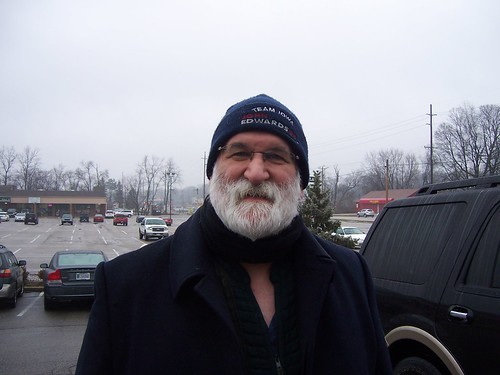
Ohio activist Alec Johnson


1:06 minutes (1.01 MB)

You've convinced me... Now go out and make me do it.

Ellen Baumgarter

The quote is apocryphal, but Ellen Baumgartner is a local activist who is holding on to the "make-me-do-it" method for getting Obama to deliver at least some of the changes he promised during his campaign in '08. A couple of weeks after being jailed for civil disobedience in protest against the Keystone XL tars sands pipeline, Baumgartner said she supports Obama's reelection.

"I believe in Obama. I think he has had tremendous challenges. But he has done a number of good things. People are expecting too much of him, because he has inherited a mess. Now, with the Congress being so antagonistic and determined to not give him anything that he wants, it's very discouraging. However, if the choice is between Obama and a Republican of the ilk we have been seeing, it's Obama hands-down."

In late August police arrested more than 1200 people near the White House. Protestors took part in civil disobedience against Keystone XL. It was part of a two-week long effort to send a message to Obama and the rest of our country.

The proposed pipeline would carry tar sands oil from Canada to Texas where it would be refined and sent to other countries. The project has united many environmentalists and human rights activists who say tar sands oil extraction violates the land rights of indigenous people in Canada and exacerbates climate change.

"We should let him (Obama) know what his supporters want him to do... He has the power to say no (to Keystone XL). He doesn't need Congress to approve of his decision."


4:55 minutes (4.51 MB)

Rev. Kujenga Eliyah Ashe on building a mass movement

Rev. Kujenga Eliyah Ashe and K. Lanai Ashe.
Rev. Kujenga Eliyah Ashe and K. Lanai Ashe near the Fort Hayes High School where President Obama spoke during his visit to Columbus to highlight his jobs plan

Ashe is the executive director of Community Organization for Abundant Life COAL I asked him what he thought of the environmental movement.

"The Earth is being raped by multinational corporations. They're polluting the Earth. Instead of using the solar power and wind power that they could be using...they're using fossil fuels. They're doing that because there's so much profit in it."

Ashe said he and fellow activists are pushing for an economic rights movement.

"The civil rights movement which Dr. King led has done great things. We even have a president w/ brown skin. So his dream has come true in terms of civil rights. But Dr. King, before he was killed, was starting to push for economics. He was boycotting different corporations and was planning a poor people's march on Washington, just like up in Chicago. They still have the Poor People's Campaign headed by Jerry Robinson."

Ashe said an economic rights movement lends itself to being broadly inclusive.

"The Civil Rights Movement helped all people-- black, white, red, yellow, gays, women. Everybody piggybacked on the Civil Rights Movement. Now we have our civil rights. We can vote. We have the franchise and (Black) mayors, congresspeople, senators, and even the president of the United States...Now we need our economic rights."

Ashe said the first program of that economic rights movement is repatriation and reparations for all descendants of slavery.


13:35 minutes (12.44 MB)

How can the mostly white middle class environmental movement engage w/ Black & low-income communities ?

Kimberly Jackson Morris & Jamira Jamison

tomover@thecolumbusactivist.org

Morris and I spoke during President Obama's visit to Columbus on Sept 13. Most of the protestors who had been there to tell Obama to not approve the Keystone XL Pipeline project had left. Keystone XL would carry tar sands oil from Canada to Texas where it would be refined and shipped to other countries.

There were no people of color in the protest, though a Black elder sat nearby on a lawn chair so as to stay in the shade during the hot September day.

Morris said the under-representation of people of color in the environmental movement is a case in point on the importance of education.

"We're not educated on those facts...When you go into lower economic areas, there's no one standing there giving us information about a pipeline."

Morris said white middle class, environmental activists should spend time in Black and low-income parts of town.

"Go into those communities and talk to people. There are people who aren't too busy to listen. But the information isn't there. Do you go into these communities and speak w/ people about these things that you're protesting ? I'm talking about urban communities."

Morris said standing in the streets holding signs won't necessarily engage people who aren't currently involved with environmental and other causes.


6:57 minutes (6.36 MB)

Ohio Congressman Tim Ryan on taxes, fracking, and rebuilding US manufacturing.

Ohio Congressman Tim Ryan

In the photo above: Ohio Congressman Ryan and Ashley Allison a Franklin County organizer for Obama for America (OFA) talk outside the Short North Tavern on Sept 15.

Ryan was in Columbus to help fight against Ohio SB 5 and Ohio HB 194. After speaking with Ryan, I'm inspired, surprised and confused.

I'm inspired ordinary people such as myself can engage with politicians who spend much of their time in D.C. But
I'm surprised he said fracking (if done right) is a way to address Global Warming. And I'm confused by his support for a flat tax that is somehow progressive. I didn't know the two were compatible.

First, the congressman's remarks about taxes, then on to fracking and rebuilding US manufacturing.

Tom Over : What is your opinion on raising taxes on big corporations and the super wealthy. 1 percent of the US population controls 40 percent of the wealth. Meanwhile we're hearing about cuts to education and union busting affecting cops and firefighters. What's your opinion on progressive taxation ?

Congressman Ryan: I've been one of the few voices in Congress over the past couple of years making sure we do ask the top 1 percent to pay more. I don't think we have anything to be ashamed of.

If you look at the income that was controlled by the top 1 percent in the late 70s, it was about 9 percent of all the income in the country. Now the top 1 percent controls about 25 percent of real income in the country.


4:42 minutes (4.3 MB)

Andrew Sidesinger to President Obama: Stop the Keystone XL Pipeline

Andrew Sidesinger

Andrew Sidesinger and about two dozen other activists were on Cleveland Avenue chanting and holding signs to remind President Obama he has the authority to reject the Keystone XL Pipeline plan.

Sidesinger said tar sands oil extraction violates the rights of indigenous people in Canada, and that it has an enormous amount of green house gas emissions.

"The tar sands is an incredibly dirty project. It destroys a beautiful pristine forest in Canada. It destroys, for every one gallon of gasoline made, 20 gallons of water."

As for why such an environmentally destructive plan is even being considered in the first place, Sidesinger said, "There are a lot of heavily invested oil companies and pipeline companies and people who want to make more money...Everybody drives cars and everybody wants more oil. They want cheap oil."

But this project won't lower oil or gas prices, Sidesinger said.

"Demand is skyrocketing. We need to find ways to reduce our usage, not continue these insane projects. There has to be a limit to what we as a society thinks is reasonable for ways to get our energy. We're scraping the bottom of the barrel, which you saw with BP and the Gulf of Mexico disaster. We're now in the Arctic drilling, where there are no resources to clean up a spill, and we're destroying a beautiful forest and turning it into a moonscape."

Sidesinger said there are better options for getting our energy.


4:31 minutes (4.13 MB)

Danny Berchenko to President Obama: Stop the Keystone XL Pipeline

Danny Berchenko

Berchenko, the Ohio organizer for 350.org, an international climate change organization, was there on Cleveland avenue for a demonstration in view of Obama's motorcade as it passed on its way to Fort Hayes Arts and Academic High School where the president highlighted his jobs plan yesterday.

"We're here today to put the pressure on Obama to stop the permitting of this destructive pipeline--the Keystone XL--which would carry dangerous tar sands from Canada down to the US gulf coast."

Berchenko said the Keystone XL plan is dangerous for many reasons.
"It (tar sands oil) is the dirtiest form of fossil fuels on the planet. And the pipeline itself would be running over very sensitive ecosystems. One of them is the Ogallala Aquifer which supplies fresh drinking water for 20 million Americans."

He said the pipeline would also open up the Canadian tar sands to full extraction potential.

"Leading climate scientists have said if we burn the tar sands it's essentially game over in terms of climate change. It's a game-over scenario for the planet. We should not even be considering opening up the tar sands to full extraction. We should be doing everything we can to get off oil, to get beyond fossils."

Berchenko said he and other activists were there to remind Obama of the promises he made during his campaign in '08.

"He said that w/ his ascension to the presidency it would mark the beginning of the time that the rise of the oceans began to slow and the planet began to heal. And we're here to remind him of that promise."

Berchenko said the administration has not issued any statement regarding these demands.


6:04 minutes (5.56 MB)

Pejmaan Fallah supports the rights of immigrant farm workers

Fallah said though this demonstration is in Columbus Ohio, it is part of a movement to improve the lives of workers all over the world.

“In my opinion, all these issues are interconnected…although we’re standing here today to support the rights of farm workers which happen to be mostly immigrants, the rights of American farmers are also being violated.”

He said the corporatist attack on workers is systematic and has been going on for a long time.

Fallah is from Iran.

“ I come from a land of oppression. It used to be oppressive before the Islamic Revolution and more oppressive even after the revolution. Ever since I can remember, I have been sensitive to the issues of poverty, injustice, human rights violations, and civil rights.”

Fallah agreed activists in the US have options that our counterparts in many other countries don’t.

“I think it’s the responsibility of everybody to stand up for the rights of others…If there are people who are not in a position to stand up for their rights (such as immigrant farm laborers who don’t speak English), then we’re responsible to stand up for their rights.”

“The fact that we can be here (in the shopping center where a Kroger store is located) is a good right, although it gets ignored because, unfortunately, a lot of people here are very disconnected.

“ I don’t mean to say they’re insensitive, but their lack of reaction (to the demonstration) may indicate there’s some degree of insensitivity. Also there’s a degree of comfort here which you may not find in other countries.

“Because ‘as long as I get my tomatoes for the lowest price and I get my clothing, I don’t care whether the sweatshop workers in Syria are getting raped, or if in Indonesia and other countries there’s abuse and slavery going on.’ Whether it’s in this country, which is happening, or in other countries there’s that attitude which is like ‘hey, as long as I’m ok and getting my stuff, then let it be.’”


6:44 minutes (6.17 MB)
Syndicate content